
You can go fishing in Japan on a normal holiday, and some of the best trips need no gear and no experience at all. The thing to know first is that there's no national fishing license: each lake sets its own rules, from free to about ¥1,500 a day, and a few of those rules surprise almost every visitor. This page covers the basics and the easiest trips from Tokyo and Kyoto, and links to a full guide for each lake.
Do you need a fishing license?
Japan has no national fishing license. Instead, fishing rights on most lakes and rivers belong to local fisheries cooperatives, and each one sets its own permit, if any. On the six lakes we cover, that works out like this:
- No permit for rod fishing: Biwa, Kasumigaura and Saroma.
- Cheap day permit: Ogawara, ¥300.
- Permit required: Inawashiro (¥700–1,500 a day, depending on shore or boat and where you buy it) and Suwa (¥1,000 in advance, ¥1,500 on the spot). On a Suwa dome boat, you buy it at the counter with your ticket.
The full lake-by-lake rules, including closed seasons and size limits, are in our rules guide.
The easiest ways to fish without bringing gear
A heated dome boat on Lake SuwaSep–Mar
The most visitor-friendly fishing in Japan. The ticket covers a rod, a rig and bait, you sit in a heated cabin, and a two-hour session for 2026–27 costs about ¥4,300 plus the ¥1,000 permit. Booking is often by phone, so a hotel front desk can help. Lake Suwa guide.
A bass guide on Lake BiwaAll year
Several guide services on Biwa work in English, and many include tackle and pickup from Otsu or Kyoto. A guide also takes care of the boat-license question. Lake Biwa guide.
Ice fishing at Anenuma, Lake OgawaraJan–Mar, ice permitting
Tents, ice drills, rods and boots can all be rented, and the permit is ¥300. It only runs while the ice is safe, and some winters it barely opens. Lake Ogawara guide.
A rental boat on KasumigauraSpring to autumn
Rowboats from around ¥2,500 a day near Tsuchiura, no license needed. Bring your own rod, or ask the shop. Lake Kasumigaura guide.
Day trips from Kyoto and Osaka
Lake Biwa is the obvious one, and it's close. On the JR lines from Kyoto Station:
- Otsu (south basin): about 10 minutes.
- Kusatsu and Moriyama (south basin, where many rental and guide boats are): about 20–25 minutes.
- Katata and Ogoto-onsen (near the bridge): about 20 minutes.
- Hikone and Nagahama (north basin): about 50–60 minutes.
From Osaka, add roughly half an hour. In April to June and September to November the bass fishing is at its best, and Biwa trout are open from December to September with an approved charter.
Day trips from Tokyo
- Kasumigaura: about an hour on the JR Joban Line from Ueno to Tsuchiura, where the rental-boat shops are. The easiest lake day trip from Tokyo, and best in spring and autumn.
- Lake Suwa: about 2–2.5 hours on the Azusa limited express from Shinjuku to Kamisuwa. It works as a long day trip in dome-boat season, but an overnight at the Kamisuwa hot springs makes it far more relaxed.
- Lake Inawashiro: about 1.5 hours on the Tohoku Shinkansen to Koriyama, then 35–45 minutes on the JR Ban'etsu West Line. Doable in a day, but the lake is big and a car helps a lot.
Worth an overnight trip
- Lake Ogawara (Aomori): Tohoku Shinkansen to Hachinohe, then the Aoimori Railway north, or fly to Misawa, about 15–20 minutes by car from Anenuma. Go in winter for the ice or in July and August for shijimi.
- Lake Saroma (Hokkaido): fly to Memanbetsu, then about 1 hour 20 minutes by car. Public transport is limited, so a rental car is close to essential. Go in summer and autumn for salmon, or spring for flounder.
To match the trip to the season, see the month-by-month calendar.
Rules that catch visitors out
- No releasing bass on Biwa. Shiga Prefecture bans releasing largemouth bass, smallmouth bass and bluegill. Use the lakeside collection boxes instead.
- Never move invasive fish alive. Anywhere in Japan, carrying a live bass, bluegill or channel catfish away from the water breaks national law. On Kasumigaura you may release them where you caught them.
- No lures on Lake Suwa. Lure fishing is banned on the lake and its rivers.
- Never take shellfish at Saroma, and at Ogawara only in the summer shijimi area, by hand.
- Your boat license from home doesn't count. Boats under 3 m with engines under 1.5 kW (about 2 hp) need no license. Anything bigger means a Japanese license or a guide.
- No night fishing on Inawashiro. It's an outright ban.
Each rule and price here comes from our lake guides, which link the official sources behind them: Shiga, Ibaraki, Fukushima, Nagano and Aomori prefectures, and the fisheries cooperatives of each lake. Prices are for 2026 or the 2026–27 season, and rules change, so check the guide for your lake before you go.
Manners, and a few words of Japanese
Most of Japan's lakeshores are also someone's workplace or farmland. Park where it's allowed, keep clear of nets and fishing operations, take your rubbish home, and give other anglers more room than you'd expect. A greeting goes a long way.
ここで釣りをしてもいいですか?Koko de tsuri wo shite mo ii desu ka?
"Is it OK to fish here?" The most useful question at any harbor or bank.
遊漁券はどこで買えますか?Yugyoken wa doko de kaemasu ka?
"Where can I buy a fishing permit?" For Inawashiro, Suwa and Ogawara.
More phrases, and the etiquette that goes with them, are in lake fishing manners & Japanese phrases.
Pick the lake that fits your base and the season, check its permit and rules, and book the boat or guide a few days ahead. That's most of the planning done.
Made by us
TsureruKana
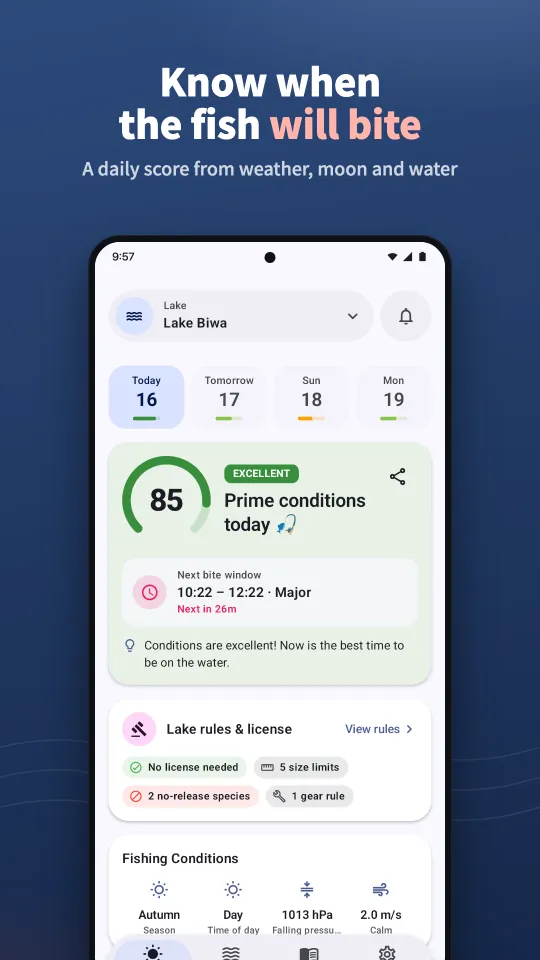
Our app scores each day on all six lakes, shows the feeding windows and lists each lake's permit, size limits and no-release species, so the rules travel with you. It's worth checking alongside the weather, not instead of it.

iPhone version coming soon · See everything the app does