
Forget bass. Lake Saroma is a lagoon, cut off from the Sea of Okhotsk by a long sandbar and connected to it through two openings, so its water is as salty as the sea itself. That changes everything about how you fish it. Here you're bait-fishing for flounder in spring, casting for salmon in summer and autumn, and catching smelt through the ice in winter, all around one of Japan's most important scallop-farming waters.
A lagoon that's nearly all seawater
Saroma is the largest lake in Hokkaido and the third largest in Japan, after Biwa and Kasumigaura. It's also Japan's largest brackish lake, though "brackish" undersells it: surveys find seawater-level salinity from the surface to the bottom.
A narrow sandbar about 25 km long separates the lake from the Sea of Okhotsk. Two gaps connect them. The First Lake Mouth is a natural opening about 300 m wide in the middle of the sandbar, and the Second Lake Mouth is a channel cut in 1979 to improve water exchange. Those two openings, and the fishing ports built beside them, are the center of Saroma's fishing.
The lake is also a working farm. Scallop cultivation started here in the 1930s, and today scallop and oyster farming, run by local fishery cooperatives, covers much of the lake.
What you can catch
- Kurogashira flounder (kurogashira-garei): Saroma's signature shore catch, and the reason ports fill up with anglers in spring.
- Pink and chum salmon: run past the lake mouths in summer and autumn, when many anglers switch to targeting them.
- Chika: a small smelt, caught on sabiki rigs and, in winter, through the ice. It's a different fish from the wakasagi of Suwa and Ogawara, though it looks similar.
- Komai (saffron cod): a small cod caught on bottom rigs, and another winter favorite.
Scallops, oysters and Hokkai shrimp are what Saroma is famous for, but they belong to the fishery cooperatives. They're for eating in local restaurants, not for catching (see the rules below).
When to go
Flounder fishing starts around March and peaks from April to June, when the fish move in to spawn. The ports get especially busy around Golden Week in early May.
Pink salmon come first, from summer, and chum salmon follow into autumn. Early morning is the classic window.
In cold winters parts of the lake freeze, and people fish for chika through the ice. In the coldest months, some anglers also drop baits straight down the gaps along harbor walls for flounder. Ice varies from year to year, so ask locally before walking out onto it.
For open-water fishing, April to November is the main season.
Where people fish
Most fishing happens from the fishing ports around the lake mouths, rather than from open shoreline.
- Sakaeura port (Kitami side, near the First Lake Mouth): one of the most popular spots. You can park right by the water, and it produces flounder, chika and komai.
- Second Lake Mouth port: known for especially good numbers of fish, and sometimes huge catches. Most people cast bottom rigs from the embankment on the lake side.
The methods are simple bait fishing: weighted bottom rigs for flounder and komai, and sabiki or float rigs for chika. A tackle box full of bass lures won't help much here. There's more on that in the lures people actually use here.
Ports are working spaces. Don't fish where signs say no fishing, stay clear of boats and gear, and wear a life jacket on harbor walls.
The rules, starting with shellfish
Never take shellfish, anywhere on the lake
This is the one rule to take seriously. The fishery cooperatives hold fishing rights for scallops, oysters and other shellfish across the entire lake. Picking up a scallop, an oyster or a sea cucumber, even one lying loose in the shallows, counts as poaching under Japan's fisheries law, and infringing fishing rights can carry a fine of up to ¥1 million. It doesn't matter that you only meant to eat it yourself.
No license for fishing with a rod
Saroma is fished as sea water, and Japan doesn't require a license for recreational rod fishing in the sea. Keep clear of the aquaculture rafts and working areas, and follow any posted restrictions at the ports.
Salmon: check river-mouth closures
Hokkaido bans salmon and trout fishing in rivers altogether, and sets seasonal no-fishing zones around many river mouths along the coast. They reach up to 1,000 m around the biggest rivers. Before you fish for salmon anywhere near a river mouth, check that year's list of closures from the Hokkaido government.
Hokkaido government's fishing rules & manners, including the annual salmon river-mouth closures; Hokkaido Research Organization lake data; and the government's guide to poaching rules (all in Japanese). Rules change, so check them before a trip.
Getting there
- By air: Memanbetsu Airport, near Abashiri, is the closest. From there it's about 1 hour 20 minutes by car to the Wakka area near the First Lake Mouth.
- From Abashiri: about an hour by car.
- Public transport: limited. Buses reach parts of the lakeshore, but the fishing ports are spread out, and a car is close to essential.
The Wakka Primeval Flower Garden, on the sandbar near Sakaeura, is Japan's largest coastal grassland, with the lake on one side and the Sea of Okhotsk on the other. The nature center rents bicycles and is open from late April to mid-November. Saroma is also known for its sunsets, and in autumn patches of glasswort turn the shoreline red.
カレイは釣れていますか?Karei wa tsurete imasu ka?
"Are the flounder biting?" A good opener with other anglers on a harbor wall in spring.
氷の厚さは大丈夫ですか?Kori no atsusa wa daijobu desu ka?
"Is the ice thick enough?" Ask this before you step onto the ice, not after.
More phrases, and the etiquette that goes with them, are in lake fishing manners & Japanese phrases.
Moon phase on a lake with a real tide
Saroma is the one lake on this site where moon phase has real physics behind it. The tide flows in and out through the two lake mouths, and moving water is a genuine reason fish feed harder. That's also why the ports beside the mouths fish so well.
The useful version of solunar timing here is simple: look for a major period that overlaps a moving tide, not slack water, and fish the mouths then. The details are in how moon phase affects your bite window.
Bring bait rigs, a car, and warm layers, fish the ports on a moving tide, and leave every shellfish exactly where you found it.
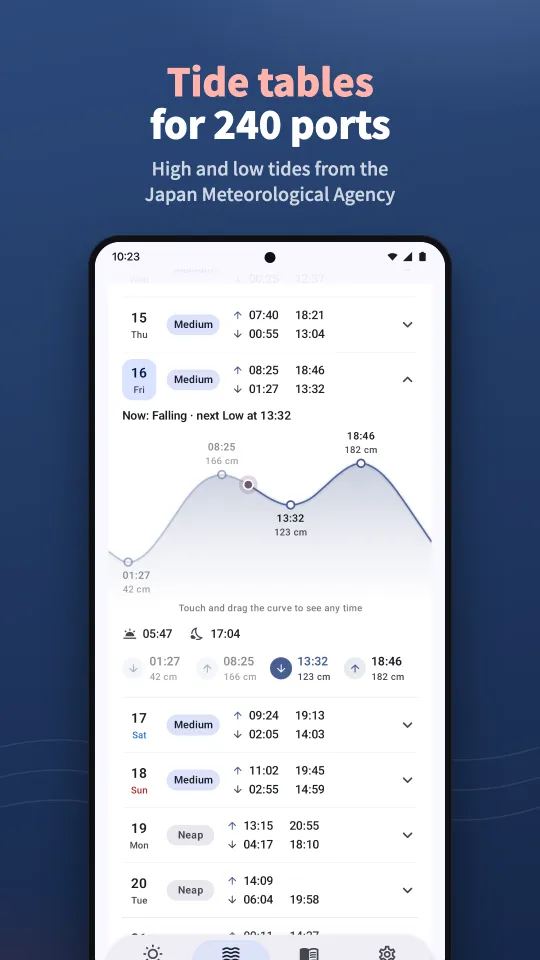
Made by us
TsureruKana
Our app scores major and minor feeding windows for Lake Saroma day by day. On a tidal lake like this one, check them alongside the tide table and the weather.

iPhone version coming soon · See everything the app does