
Fishing etiquette in Japan is mostly common sense, but a few specifics are worth knowing before you go — where written rules leave off, unwritten ones pick up. Below is what's actually documented about fishing manners here, a few things specific to the six lakes we cover, and a short list of Japanese phrases that solve real, practical situations: asking permission, renting gear, and being a decent neighbor to whoever's fishing next to you.
The etiquette that matters most
None of this is law — it's documented custom, the kind that determines whether the person next to you is glad you showed up.
- Keep your distance. The common guideline is 5–10 meters from another angler. Lines tangle at closer range, and a hook flying past someone at that distance is a real, not theoretical, injury risk.
- Greet people. A simple hello to anglers already at a spot is considered genuinely important in Japanese fishing culture — more so than small talk generally.
- Pack out everything, including your line. Cut-off fishing line left behind is a real hazard to birds and other wildlife. Many regular anglers carry a small pouch or winder just for used line and other trash rather than leaving anything at the spot.
- Keep quiet, especially early or late. Voices carry over water, and so do car doors and idling engines in a quiet pre-dawn parking area — a real complaint source near residential shorelines.
- Don't light up the water at night. Shining a light across the surface when others are fishing scatters fish for everyone nearby; step back from the water to change lures or bait instead of doing it right at the edge.
- Keep gear compact on breakwaters and paths. Spread-out tackle blocks foot traffic and gets stepped on — pack tight wherever people need to walk through.
- Stay off private facilities. Aquaculture pens and enclosed fish-farming areas (ikesu) are someone's livelihood, not a fishing spot, even when they're not clearly marked.
- Wear a life jacket. Standard safety advice at every official source we checked, for both bank and boat fishing.
Japan Association for Construction Human Resources, fishing etiquette guide — nippon.jac-skill.or.jp
A few things specific to these six lakes
The general etiquette above applies everywhere. A few points are specific enough to these lakes that they're worth repeating here, with more detail on our rules by lake page.
- Biwa: releasing caught bass or bluegill is banned — put them in one of the invasive-fish collection boxes around the lake, or kill them and take them home.
- Kasumigaura: catch-and-release on the spot is allowed, but never carry a bass, bluegill, or channel catfish away alive — if you're keeping it, kill it first.
- Saroma & Ogawara: large parts of both lakes are working aquaculture water for scallops, oysters, and shijimi. Stay on public bank and port areas rather than near the rafts and cultivation zones.
- Suwa: lure fishing is banned entirely on the lake and its connected rivers — don't assume the rules from a bass lake carry over here.
- Inawashiro: night fishing is prohibited outright, not just discouraged.
Phrases for getting set up
These are the ones that solve an actual problem: whether you're allowed to fish somewhere, where to get a permit, or how to rent a rod.
ここで釣りをしてもいいですか?Koko de tsuri wo shite mo ii desu ka?
"Is it okay to fish here?" — worth asking if a spot looks informal or you're not sure it's open to the public.
遊漁券はどこで買えますか?Yugyoken wa doko de kaemasu ka?
"Where can I buy a fishing permit?" — useful at Suwa, Inawashiro, or Ogawara, where one is actually required.
立入禁止ですか?Tachiiri kinshi desu ka?
"Is this off-limits?" — a quick way to check before stepping past a rope, buoy line, or unclear boundary.
竿を借りたいですSao wo karitai desu
"I'd like to rent a rod" — the basic line at any rental counter or tackle shop.
近くに釣具屋はありますか?Chikaku ni tsuriguya wa arimasu ka?
"Is there a tackle shop nearby?" — good for a forgotten hook or a last-minute bait run.
いくらですか?Ikura desu ka?
"How much is it?" — pairs with almost everything above.
Phrases for while you're fishing
The social ones — the small talk that greeting culture actually expects.
こんにちはKonnichiwa
"Hello" — the standard daytime greeting to an angler already at the spot.
おはようございますOhayou gozaimasu
"Good morning" — genuinely the more common greeting at a dawn spot, since so many people arrive early.
何が釣れていますか?Nani ga tsurete imasu ka?
"What's biting?" — a completely normal opener with a neighbor, and often genuinely useful information.
大きいですね!Ookii desu ne!
"That's a big one!" — the natural thing to say about someone else's catch.
すみませんSumimasen
"Excuse me" / "sorry" — for getting someone's attention, or for a tangled line that was your fault.
お先に失礼しますOsaki ni shitsurei shimasu
Literally "excuse me for going ahead of you" — the polite thing to say when you're leaving a spot before the people near you.
ありがとうございますArigatou gozaimasu
"Thank you" — for advice, a tip on bait, or anything else a neighbor shares with you.
None of these require fluent Japanese to land. Saying even one of them, even imperfectly, tends to go a long way at a fishing spot where greeting people is already part of the culture.
Made by us
TsureruKana
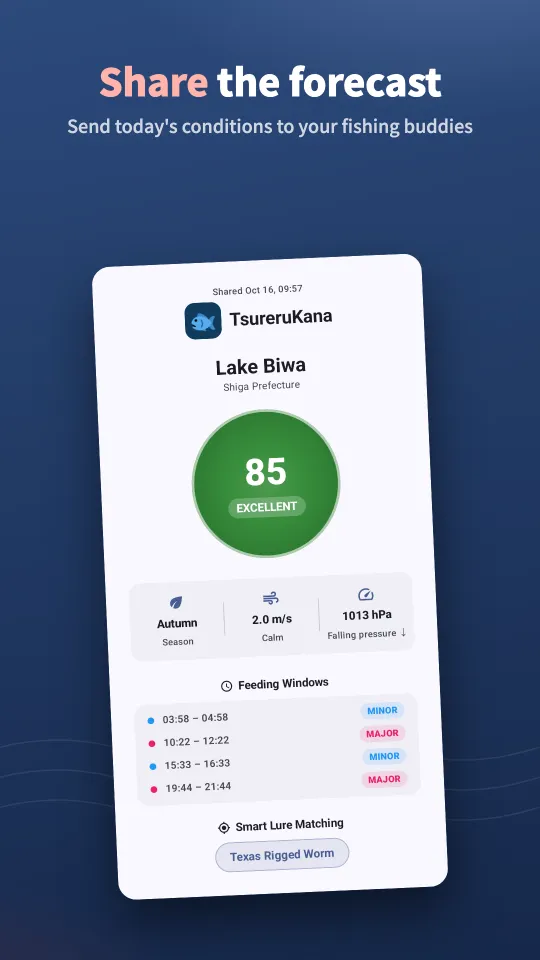
We also build an app that scores major and minor feeding windows for each of the six lakes on this site using solunar theory — worth checking alongside the weather, not a guarantee — plus a lure-matching suggestion for what's likely working right now.

iPhone version coming soon · See everything the app does