
Lake Suwa is tiny next to Biwa or Kasumigaura, but in winter it's one of the best-known fishing spots in Japan, for one fish: wakasagi, the pond smelt. People used to catch them through holes in the ice. Today the lake rarely freezes safely, so they're caught from dome boats: heated, covered boats moored out on the water, with a rod and bait included in the ticket. You don't need any gear or experience, which makes it one of the easiest ways for a visitor to go fishing in Japan.
A small lake with a big winter reputation
Suwa sits in a basin in the mountains of central Nagano, ringed by the towns of Suwa, Okaya and Shimosuwa. It's shallow, averaging under 5 m deep and nowhere much deeper than 7 m, and at 759 m above sea level it gets properly cold in winter. The lakeside Kamisuwa Onsen hot-spring district and the Suwa Taisha shrines make it an easy place to turn a fishing trip into a weekend.
The lake that stopped freezing
Suwa is famous for omiwatari, a ridge of ice that pushes up across the frozen lake in the coldest winters. Local shrines have kept records of it for around 600 years, and in the past it appeared most winters. It hasn't appeared since 2018, and in February 2026 the shrine declared an ake-no-umi ("open sea") winter for the eighth year running. With the lake rarely freezing thick enough to stand on, fishing on the ice is now banned in principle for safety, and the dome boat has become how winter fishing happens here. Suwa is often called the place where wakasagi dome boats began.
What a dome-boat trip is actually like
A dome boat is a covered, heated boat that sits out on the lake while you fish. You sit inside out of the wind, drop a light multi-hook rig straight down, and watch a very sensitive rod tip for the tiny tap of a wakasagi. It's quiet, social, and completely unlike casting for bass.
- Operators: the lake's sightseeing-boat companies, lakeside guesthouses, and small fishing-boat businesses all run dome boats. The Suwa tourism association's site lists the main ones.
- Price: for the 2026–27 season, a two-hour session at the lakeside operators we checked costs about ¥4,300 for adults and ¥3,300–3,700 for children, plus the ¥1,000 day permit for adults (junior-high age and under fish free). Some operators charge non-fishing companions about ¥1,500.
- What's included: the boat, a rod, and a first rig and bait. The permit is often paid separately at the counter, in cash. Bring warm clothes and you're set.
- Booking: usually by phone, and worth doing early for weekends from December to February.
- Eating your catch: wakasagi are best as tempura. Some operators can cook the catch or send you to a partner restaurant that will, while others don't cook at all. Ask when you book.
The standard rig is a string of very small hooks on fine line, baited with beni-sashi, a small red maggot. Early in the season, from shore, locals switch to unbaited "fiber" rigs with shiny strands on the hooks, because the young fish are only eating plankton. More on why a bass tackle box is useless here is in the lures people actually use here.
When to go
Surprisingly, shore fishing is often at its best in early autumn, before the dome boats go out. The fish are small at this point, around 6–7 cm. A popular spot is the Kamaguchi sluice gate in Okaya, where the lake drains into the Tenryu River.
Dome boats usually start between late September and October and run into March. For 2026–27, one Okaya operator opened on September 26. Exact dates vary by operator and by year. November through March is the main season, and December to mid-February is the most popular stretch, so it's also when boats are most likely to be full.
Sessions run at fixed times, typically two-hour slots through the day. Early slots tend to fish better, and the cooperative asks anglers to avoid fishing at night and in the early morning in winter for safety.
A fish stock that's had hard years
It's worth knowing that Suwa's wakasagi haven't had an easy decade. In July 2016, a mass die-off caused by low-oxygen water killed large numbers of wakasagi and other fish. The stock has swung sharply since. The cooperative's autumn 2022 estimate described an abundant year, while in autumn 2023 the estimated population was only about 40% of the five-year average, and the spring 2024 egg collection was the lowest on record.
In response, the Suwako Fisheries Cooperative has set voluntary limits in recent seasons, asking anglers to fish only between 7:00 and 15:30 from December to May and closing spawning areas. In a thin year, catches can be modest, so check the cooperative's current notices before you go, and treat a big haul as a bonus rather than a promise.
The rules: a permit, and no lures
You need a permit
The Suwako Fisheries Cooperative holds the fishing rights for the lake and the rivers flowing in and out of it. A day permit for rod fishing costs ¥1,000 bought in advance or ¥1,500 on the spot, and an annual permit is ¥6,000. Junior-high-school students and younger fish free. On a dome boat, you usually buy it at the counter along with your ticket.
No lures, and limits on reels
- Lure fishing is banned outright on the lake and its connected rivers.
- Reels are only allowed for wakasagi, carp, or fly fishing, and even then, casting with a weight isn't allowed.
- Fishing on the ice is banned in principle for safety, even in the rare years it freezes.
- Some areas are closed from January 1 to May 31 to protect spawning fish. They're marked on the shore, and the cooperative can announce more closures.
Suwako Fisheries Cooperative: official rules and seasonal notices (Japanese). 2026–27 prices are from operators such as Wakasagi Lakehood, and the omiwatari record from Nagano Prefecture. Dome-boat operators are listed by the Suwa tourism association. Prices and dates change each season, so confirm before booking.
Getting there
- From Tokyo: the Azusa limited express from Shinjuku to Kamisuwa takes about 2–2.5 hours. The lakeshore and most dome-boat piers are a short walk or taxi ride from the station.
- From Nagoya: about 2.5 hours, on the Shinano limited express to Shiojiri and then the JR Chuo Line to Kamisuwa.
- By car: the Chuo Expressway's Suwa interchange is close to the lake.
For the classic view down over the lake, head up to Tateishi Park on the hillside above Suwa city. It's the viewpoint many visitors know from the animated film Your Name.
ドーム船を予約したいです。Domusen wo yoyaku shitai desu.
"I'd like to book a dome boat." Most bookings are by phone, so this is the opening line.
釣った魚を天ぷらにできますか?Tsutta sakana wo tenpura ni dekimasu ka?
"Can the fish we catch be made into tempura?" Worth asking before you book, since operators differ.
More phrases, and the etiquette that goes with them, are in lake fishing manners & Japanese phrases.
Moon phase in a heated cabin
Suwa is a shallow, closed freshwater lake, so there's no tide for the moon to drive, and solunar tables are a rule of thumb here rather than physics. Dome-boat sessions also run at fixed times, so you can't chase a feeding window minute by minute anyway.
Where the tables can help is choosing which slot or day to book: if a major period overlaps an early session, that's a reasonable tiebreaker. The reasoning, and its limits, are in how moon phase affects your bite window.
Book the boat, dress for a cold lake, and ask about tempura. At Suwa, the fishing is the easy part.
Made by us
TsureruKana
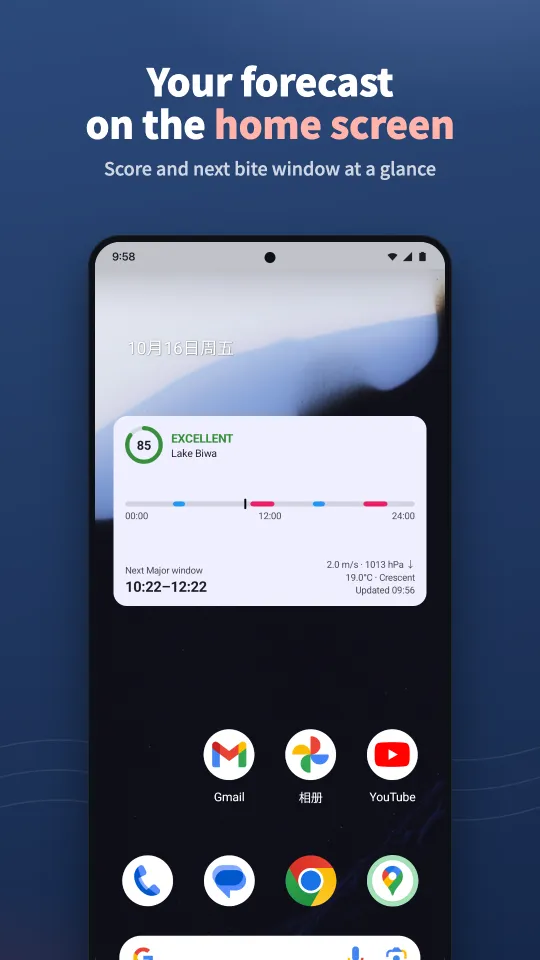
Our app scores major and minor feeding windows for Lake Suwa day by day, which is handy for choosing which dome-boat session to book. It's worth checking alongside the weather, not instead of it.

iPhone version coming soon · See everything the app does