
Most people come to Lake Biwa for one reason: largemouth bass, in the lake that produced a tied all-tackle world record. That's a fair reason. But Biwa is also more than four million years old, home to around sixty species found nowhere else, and big enough that its north and south ends fish like separate lakes. Knowing which half you're on, and which rules come with the catch, matters more here than which lure you tie on.
Two lakes in one: the south and north basins
The Biwako Ohashi Bridge crosses the lake at its narrowest point, about 1.35 km wide. Everything south of it is the south basin (nanko), and everything north is the north basin (hokko). They're connected, but they couldn't be much more different.
South basin (nanko)
Shallow, averaging around 4 m deep, with a soft bottom and heavy weed growth by summer. This is where most rental-boat shops and bass guides are based, around Otsu, Kusatsu and Moriyama, and where most of Biwa's bass reputation was made. It warms up first in spring, so pre-spawn fish move shallow here earlier than anywhere else on the lake. The trade-off is pressure: these fish see a lot of lures, all year round.
North basin (hokko)
Deep, averaging around 43 m, with clear water, rocky structure and far less weed. Bass are here too, but you're usually fishing deeper and covering more water to find them, and the water warms later, so spring patterns run a few weeks behind the south. The deep, cold water is also where the lake's native Biwa trout live, which makes the north basin the half to fish if you want something other than bass.
If you're booking a guide or a boat, confirm which basin you're launching from. The lake is over 60 km long, and "Lake Biwa" meeting points can be more than an hour apart.
What you can catch
- Largemouth bass: the main draw, and not native. Introduced to Japan in the 1920s and now firmly established, they're what nearly every rental boat on the south basin is chasing. Big fish are a realistic goal here in a way they aren't on most Japanese lakes.
- Bluegill: everywhere, easy to catch, and a good way to keep kids busy from a harbor wall. Also invasive, so the same no-release rule applies (see below).
- Biwa trout (biwamasu): a landlocked salmon found only in this lake. Adults can top 60 cm, feed on ayu in deep water, and are caught by trolling from a boat. They're excellent eating, which is part of why the fishery is so tightly managed.
- Ko-ayu: a dwarf form of sweetfish that spends its whole life in the lake rather than going to sea. In spring and early summer, families fish for them from harbors and river mouths with simple sabiki rigs.
- Nigorobuna: an endemic crucian carp, and the fish behind funazushi, Shiga's famously pungent fermented sushi.
- Biwa catfish (Biwako-onamazu): a giant endemic catfish that can top a meter. You're unlikely to target one, but it's worth knowing what that heavy thing on the end of your line might be.
When to go
The best shot at a trophy. Pre-spawn fish move shallow in the south basin first, usually from April, while the north basin runs a few weeks behind. Fewer bites than autumn, but bigger fish. May is the month most guides point to.
Heavy weed in the south basin makes it a game of fishing the edges and holes in the vegetation. Early mornings are the best window, and midday in August can be hard going in the heat.
Numbers pick up as fish feed up before winter. The most forgiving season, and a good one for a first trip or for beginners.
Slow, and the fish are deep. Mostly for patient anglers with a guide who knows the winter spots, though a quiet winter day can still produce a very big fish.
Open from December through September. The fishery is closed from October 1 to November 30 while the fish run up rivers to spawn.
Roughly April through August, peaking May–July. Ayu are protected from August 21, and from September 1 to November 20 you can't take them by any method, on the lake or its rivers.
The rules that actually apply here
No license, no fee
You don't need a fishing license or permit to fish Lake Biwa itself with a rod, from shore or from a boat. That changes on some rivers flowing into the lake, where upstream sections are paid fishing grounds for ayu and mountain-stream fishing. If you head upriver, check before you cast.
Bass and bluegill can't be released
This is the rule that surprises visitors most. Shiga Prefecture's Lake Biwa leisure ordinance bans releasing largemouth bass, smallmouth bass and bluegill anywhere in the prefecture, Biwa included, so catch-and-release, the norm at most bass lakes, isn't allowed here. What you're asked to do instead:
- Put the fish in one of the invasive-fish collection boxes or pens (gairaigyo kaishu bokkusu / ikesu) placed at lakeshore parks and harbors. Rental shops and guides will know where the nearest one is.
- If there's no collection point nearby, kill the fish on the spot, take it home, and dispose of it with your kitchen waste.
- Don't carry it away alive. Moving a live bass or bluegill away from the lake breaks national invasive-species law, which carries much heavier penalties. Keeping fish in a bucket while you fish, or carrying them to a collection box on the lake, is fine.
Closed seasons and size limits
- Biwa trout: closed October 1 – November 30. Fish of 30 cm or under must be released.
- Ayu (including ko-ayu): protected August 21 – November 20. Rod fishing is still allowed until August 31, and from September 1 all methods are banned.
- Nigorobuna: fish of 22 cm or under must be released. For other crucian carp and for carp, the limit is 15 cm or under.
Biwa trout from a boat needs approval
Trolling for Biwa trout from your own or a rented boat requires approval from the Lake Biwa Fisheries Adjustment Commission, which runs an application window before each season and expects catch reports. If you fish from a licensed charter boat (yugyosen) instead, you're covered by the operator's approval and don't need your own. For a visitor, booking a charter is by far the simpler route.
Boats and engines
- Conventional two-stroke outboards are banned on the lake, and every pleasure boat needs a prefectural compliance certificate. Rental shops handle this, so it only matters if you bring your own boat.
- In Japan, boats under 3 m with engines under 1.5 kW (roughly 2 hp) don't need a boating license. That's why rental shops advertise "license-free" 2-horsepower boats.
- A boating license from home generally isn't valid in Japan. Anything bigger than a 2 hp boat means either a Japanese small-craft license or a guide.
Shiga Prefecture: no-release rule, collection box locations, closed seasons and size limits, ayu closed season, Biwa trout boat approval, and the two-stroke engine ban (all in Japanese). Rules change, so check them before a trip.
Getting there and getting on the water
By train from Kyoto
- Otsu (south basin, west shore): about 10 minutes on the JR Biwako Line.
- Kusatsu and Moriyama (south basin, east shore): about 20–25 minutes on the same line. Many rental-boat shops are a short taxi ride from these stations.
- Katata and Ogoto-onsen (near the bridge, west shore): about 20 minutes on the JR Kosei Line.
- Hikone and Nagahama (north basin, east shore): about 50–60 minutes.
From Osaka, add roughly half an hour to any of these.
Shore, rental boat, or guide?
- From shore: free and open to anyone, from lakeside parks and harbor walls. Some harbors restrict fishing, so follow posted signs. Shore fishing is the easiest way to try for bass or ko-ayu without planning much.
- Rental boat: the south basin has plenty of rental shops. As a rough guide (2026), rowboats start around ¥2,500–3,000 a day, electric-motor boats around ¥5,000–6,000, and license-free 2 hp boats around ¥9,000. Bass boats with larger engines run well over ¥10,000 and need a Japanese license.
- Guide: the easiest option for a visitor. Several guide services on the lake work in English, and many include tackle and pickup from Otsu or Kyoto. A guide also takes care of the license and engine questions above.
Wind decides more Biwa days than anything else. The Hira mountains on the west shore send strong gusts down onto the lake, known locally as hira-oroshi, and they're worst in early spring. Rental shops will keep boats in on bad days, so check the forecast the night before.
外来魚回収ボックスはどこですか?Gairaigyo kaishu bokkusu wa doko desu ka?
"Where's the invasive-fish collection box?" Useful as soon as you land your first bass or bluegill.
免許不要のボートはありますか?Menkyo fuyo no boto wa arimasu ka?
"Do you have a license-free boat?" This is the 2 hp option, and the one to ask for at a rental counter if you don't hold a Japanese license.
More phrases, and the etiquette that goes with them, are in lake fishing manners & Japanese phrases.
The 22 lb 4 oz fish that put Biwa on the map
On July 2, 2009, Manabu Kurita pitched a live bluegill next to a bridge piling on Lake Biwa and, after a three-minute fight, landed a largemouth bass that weighed 10.12 kg (22 lb 4 oz) on certified scales. That matched George Perry's Georgia fish from 1932 to the ounce, a record that had stood for 77 years.
Under IGFA rules, a new all-tackle record has to beat the old one by at least two ounces, so the IGFA ratified Kurita's fish as a tie. The two men still share the largemouth record today. One fish didn't make Biwa's bass scene, but it made the rest of the world pay attention to it, and to the Japanese lure makers who grew up fishing here. More on that in the lures people actually use here.
Moon phase on a lake with no tide
Biwa is a closed body of freshwater, so the moon doesn't move a real tide through it the way it does on coastal lagoons like Saroma or Ogawara. That means solunar tables here are a heuristic, not physics. They're worth a look, but they shouldn't outrank the things that clearly move Biwa bass: water temperature, wind, light and stable weather.
Where moon phase earns its place is as a tiebreaker. If you're choosing between two mornings with similar weather, and one has a major period landing near dawn, that's the one to pick. The full reasoning, and where the evidence is weak, is in how moon phase affects your bite window.
Plan your Biwa trip around the basin first, the season second, and the forecast last, and bring a way to dispatch the fish you can't put back.
Made by us
TsureruKana
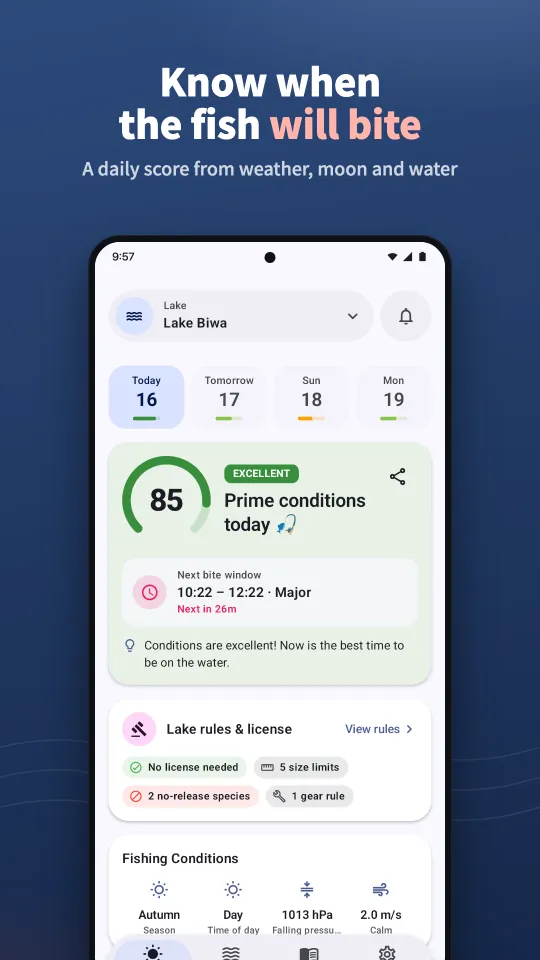
Our app scores major and minor feeding windows for Lake Biwa day by day, and its Smart Lure Matching feature suggests what's likely working right now. It's worth checking alongside the weather, not instead of it.

iPhone version coming soon · See everything the app does