
Kasumigaura is Japan's second-largest lake and the closest serious bass water to Tokyo. It's also known as a tough lake: shallow, stained, flat, and fished hard by a lot of very good anglers. That's exactly why people rate it. A bass from Kasumigaura is usually one you've worked for. The good news for a visitor is that it's easy to reach, free to fish, and mostly fished from the bank.
Big, shallow, and an hour from Tokyo
At 220 km², Kasumigaura is second only to Biwa in Japan, but it's a completely different shape of lake. It sits in the flat Kanto plain in southern Ibaraki, averages only about 4 m deep, and nowhere gets much deeper than 7 m. The main body is called Nishiura (about 172 km²). The narrower Kitaura to the east is fished and managed alongside it.
It wasn't always a freshwater lake. Kasumigaura used to be a brackish inlet connected to the sea through the Tone River, until the Hitachi River sluice gate was built in 1963 and cut off the seawater. Today the lake, Kitaura, the lower Tone River, and the network of canals connecting them are often fished as one system, which local anglers call the Kasumi system (Kasumi suikei).
How people actually fish it
With no real depth to speak of, Kasumigaura's bass relate to cover and current rather than to deep structure. Most of the fishing comes down to a few kinds of places:
- Reed beds (ashi): the classic Kasumigaura target, especially in spring, when bass move up along the reed edges. Late afternoon into evening is a favorite window.
- Riprap and embankments: much of the shoreline is armored with rock and concrete, which gives bank anglers long stretches of fishable edge.
- Sluice gates (suimon): where canals and rivers join the lake, gates control the flow. When water is moving through them, they're some of the most reliable spots on the system.
- Canals (suiro): the smaller waterways around the lake hold bass too, and they're more sheltered on windy days.
Most anglers here fish from the bank, which locals call okappari. The pressure is heavy, so finesse presentations and slow, careful fishing tend to beat covering water fast. Rubber jigs with bug-style trailers around the reeds and spinnerbaits along drop-offs are two common approaches. There's more on what's in local tackle boxes in the lures people actually use here.
Much of the bank runs past farmland and working fishing areas. Park where it's allowed, don't block farm roads or fishing operations, and check where the nearest toilet is before you settle in.
What you can catch
- Largemouth bass: the main target for visiting anglers. Spring fish in the 40–50 cm range are what people come for.
- Channel catfish: an invasive American catfish that has spread through the lake. They're big, pull hard, and take bait readily, and some anglers now fish for them on purpose.
- Carp and crucian carp: common throughout, and a traditional bait-fishing target.
- Wakasagi and shirauo: pond smelt and icefish, the lake's traditional commercial catch and the basis of local specialties like tsukudani (fish simmered in soy and sugar). Both have closed seasons (see the rules below).
When to go
The best chance at a big fish. Spawning usually gets going from mid to late April, and some of the largest bass start earlier, in March. Fish the reed edges and warming shallows.
Fishable, but hot and humid on a lake with little shade. Early mornings and evenings are the windows, and moving water near gates and in canals helps.
The season for numbers, with bass chasing bait and hitting lures more readily. Local anglers often single out September.
Slow. The shallow water cools quickly, and bites are few. It's mostly for locals who know exactly where the winter fish sit.
The rules, and how they differ from Biwa
No permit, no fee
Like Biwa, Kasumigaura and Kitaura are legally treated as a "sea district" rather than inland water, so you don't need a fishing permit, whatever you're fishing for. Fishing is governed by Ibaraki's Kasumigaura-Kitaura fisheries rules instead.
Catch-and-release is allowed here
This is the big difference from Lake Biwa, where releasing bass is banned. On Kasumigaura, Ibaraki Prefecture confirms that catch-and-release isn't restricted. What the law does restrict:
- Don't move them alive. Bass, bluegill, channel catfish and other designated invasive species can't be transported alive under the national invasive-species law. Release them where you caught them, or kill them on the spot if you're keeping them.
- Don't bring them in. Releasing invasive fish from anywhere else into the lake is banned and carries penalties.
Ibaraki runs a collection program for invasive fish like channel catfish. On set Saturdays from April to November (10:00–12:30 in 2026), you can bring fish you caught that day, already dead, to one of three collection points in Namegata or at the Kasumigaura Environmental Science Center. In return you get a small gift of local products, based on weight.
Methods, closed seasons and size limits
- Allowed: rod and handline fishing. Not allowed: chumming (throwing in groundbait), and setting fish traps or eel tubes.
- Wakasagi: closed January 21 – February 28 and May 1 – July 20.
- Shirauo: closed March 1–31.
- Carp: closed May 11 – June 10, and fish under 15 cm must be released.
- Eel: fish under 23 cm must be released.
- Protected areas: nothing may be taken inside them. They're marked with signs on the embankment, posts on the shore, and flashing buoys on the water.
Ibaraki Prefecture: fishing rules and manners, fishing Q&A, and the invasive fish collection program (all in Japanese). Rules change, so check them before a trip.
Getting there and getting on the water
From Tokyo
The JR Joban Line runs from Ueno (and through-trains from Tokyo and Shinagawa) to Tsuchiura, at the western tip of the lake, in about an hour. Tsuchiura is where many of the lake's rental-boat shops are, and it's a sensible base for a day trip. By car, the Joban Expressway runs past the west end of the lake.
Bank or boat?
- From the bank: free, open, and how most people fish Kasumigaura. With this much fishable shoreline, a car or a bike helps a lot.
- Rental boat: as a rough guide (2026), rowboats start around ¥2,500 a day and small boats without an engine around ¥3,000–3,500. A 14 ft boat with an engine and a bow electric motor runs about ¥10,000–13,000, and the engine means you'll need a Japanese boating license. The license rules are the same as on Biwa, and they're explained in the Lake Biwa guide.
From late July into autumn, the lakeside cities run tourist sailings of the hobikisen, traditional sail-trawling boats with a sail about 9 m tall and 16 m wide. They were designed in 1880 to catch wakasagi and shirauo. The flat lakeshore is also popular for cycling, with Tsuchiura as the main starting point.
ここは釣り禁止ですか?Koko wa tsuri kinshi desu ka?
"Is fishing prohibited here?" Worth asking near gates, harbors and anything that looks like a working fishing area.
今日は何で釣れていますか?Kyo wa nani de tsurete imasu ka?
"What are they biting on today?" The best question to ask at a local tackle shop or rental counter.
More phrases, and the etiquette that goes with them, are in lake fishing manners & Japanese phrases.
Moon phase on a lake behind a sluice gate
Since the sluice gate closed off the sea in 1963, Kasumigaura hasn't had a real tide for the moon to drive. Solunar tables are a rule of thumb here, not physics. The water that does move, through the gates and canals, matters far more to a Kasumigaura bass than the position of the moon.
Use moon phase as a tiebreaker: between two days with similar weather, pick the one where a major period lines up with dawn or dusk. The full reasoning is in how moon phase affects your bite window.
Come to Kasumigaura for the challenge, fish slowly around cover and moving water, and count every bass as earned.
Made by us
TsureruKana
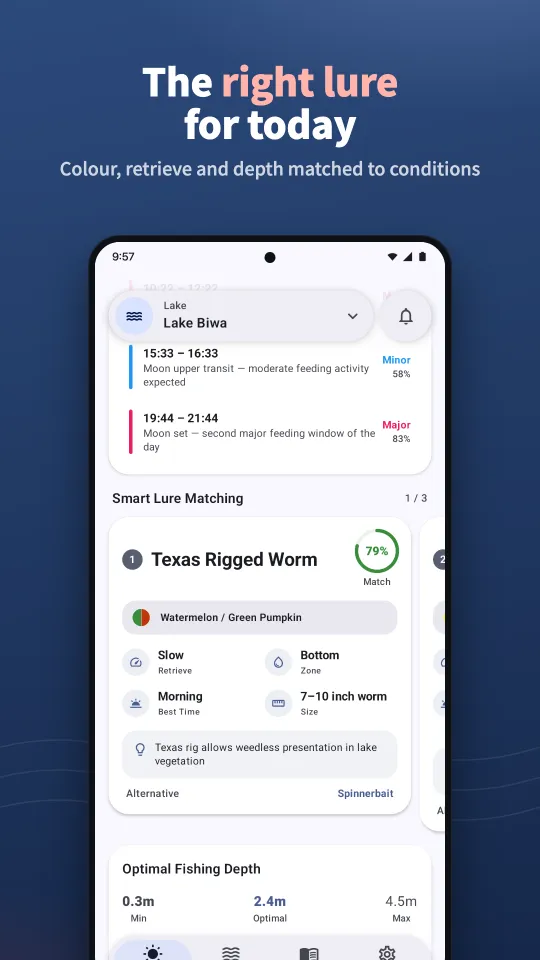
Our app scores major and minor feeding windows for Lake Kasumigaura day by day, and its Smart Lure Matching feature suggests what's likely working right now. It's worth checking alongside the weather, not instead of it.

iPhone version coming soon · See everything the app does