
For most of its history, Lake Inawashiro was famous for what it didn't have. Acidic water kept it crystal clear and short on fish, and it was ranked Japan's cleanest lake. That's changed. As the water has turned closer to neutral, the lake has become more productive, and today it's best known among anglers for smallmouth bass of a size rarely seen in Japan, along with big trout and plenty of wakasagi. You need a permit, and there's no fishing at night.
A clear, deep lake that's been changing
Inawashiro is Japan's fourth-largest lake, after Biwa, Kasumigaura and Saroma. It sits at the foot of Mount Bandai, and on calm days the mountain's reflection earned it the name Tenkyo-ko, "the mirror of heaven."
Acidic water flowing in from the volcanic area around Bandai once made Inawashiro Japan's largest acidic lake, at around pH 5. Few fish or plankton could thrive, and the water was extraordinarily clear. From 2002 to 2005, the Ministry of the Environment ranked it Japan's cleanest lake four years running.
From the mid-1990s, though, the water began turning neutral, and the center of the lake now measures around pH 6.8. More plankton means more food for everything above it, which is a big part of why fish here now grow so large. The same change has worried people who care about the lake's clarity. Its standard water-quality reading (COD) has roughly doubled from its old levels, although it's still a very clean lake.
What you can catch
- Smallmouth bass: not native, but now the lake's headline lure fish, and the fish are unusually big. On May 23, 2025, an angler fishing with a guide landed a 57 cm, 3,660 g smallmouth on a drop-shot rig. The Japan Game Fish Association certified it as a Japan record that July. Largemouth bass are present too, but smallmouth are what people come for.
- Trout: iwana (char) and yamame grow large in the lake and are fished by trolling and lake jigging from boats. Local marinas also advertise big "sakuramasu", which Fukushima protects separately (see the rules below).
- Wakasagi: plentiful, and often larger than you'd expect. They're also a big part of why everything else grows so well.
- Dace, carp and crucian carp: the lake's traditional catch, open all year and simple to fish for from shore.
When to go
The main season runs from May to November. In spring, look for heavy pre-spawn fish on shallow sandy flats around 2 m deep. The record fish came in late May.
Fish are at their heaviest and fight hardest, feeding on wakasagi and freshwater shrimp. Guides fish deep, around 8–13 m, through the day, then the 2–3 m shallows next to that deep water at dawn and dusk.
Open April 1 to September 30.
Inawashiro is too big and deep to freeze over for ice fishing. The same cooperative runs ice fishing on Lake Akimoto in Ura-Bandai when the ice allows. In 2026 it opened on February 3, closed and partly reopened over the following week, and shut again on February 12 as the ice became dangerous, so check the cooperative's notices first.
Winter here is better for watching than fishing. Around 3,000 whooper swans spend the winter on the lake, peaking in February, and wind-blown spray freezes into ice sculptures along the shore.
Where to fish
From shore
Funatsu harbor on the south shore and Joko beach on the northeast shore are two of the easier-to-reach bank spots, with drop-offs and structure close in. Weedy coves elsewhere suit slower fishing around cover. Stay out of the marked swimming areas.
By boat
This is a very deep lake, and many of the biggest smallmouth and trout come from offshore structure. Guides and marinas on the south and west sides, around Nakada Bay and Funatsu, are the usual way to get there. To launch your own powered boat, you have to apply to the cooperative in writing and buy a boat-fishing permit. Some beaches, including Matsuhashi, Tenjin, Shida and Joko, are closed to powered boats all year.
Inawashiro's smallmouth respond to a wider range of lures than you might expect, from drop-shot and Carolina rigs to metal jigs, swimbaits and vibration baits. That makes it the closest thing to Biwa's lure scene among the other lakes here. There's more on lures in the lures people actually use here.
Wind moves this lake. A steady breeze, around 3–4 m/s, pushes baitfish onto windward points, and guides often fish there. It also makes open water rough for small boats, so be sensible.
Permits and rules
You need a permit
The Inawashiro-Akimoto Fisheries Cooperative manages fishing here. Buying in advance, from the cooperative or a designated shop (including some convenience stores), is cheaper than buying on the water:
- Shore fishing: ¥700 a day in advance or ¥1,000 on the spot, and ¥7,000 for a year.
- Boat fishing: ¥1,000 a day in advance or ¥1,500 on the spot, and ¥9,500 for a year.
- Children up to junior-high age fish free, and people with disabilities pay half.
Fishing without a permit can count as infringing the cooperative's fishing rights, with fines of up to ¥1 million, so it isn't worth skipping.
The other rules
- No night fishing. This is an outright ban, not just a matter of manners.
- Seasons: carp, crucian carp and dace are open all year. Iwana and yamame run April 1 – September 30, and wakasagi October 1 – March 31.
- Size limits: crucian carp and dace under 6 cm, and carp, iwana and yamame under 15 cm, must go back.
- Sakuramasu: Fukushima's inland fishing rules protect sakuramasu year-round. If you catch a big silver trout, ask your guide or the cooperative before you keep it.
- Closed areas: including stretches near eel weirs from May to July and around water intakes all year. They're marked, and the cooperative lists them.
- Bass: the national invasive-species law still bans moving bass alive. Fukushima's published fishing rules don't include a release ban for Inawashiro, but check with the cooperative if you're unsure.
Inawashiro-Akimoto Fisheries Cooperative: rules, permit prices and notices; Fukushima Prefecture's inland fishing limits; and Aizuwakamatsu City's page on the lake's water quality (all in Japanese).
Getting there
- From Tokyo: take the Tohoku Shinkansen to Koriyama (about 1.5 hours), then the JR Ban'etsu West Line to Inawashiro (about 35–45 minutes).
- From Sendai: about 50 minutes to Koriyama by Shinkansen, then the same connection.
- Around the lake: the shore is long, and the fishing spots are spread out, so a car makes things much easier.
The north shore near Inawashiro town is also home to the Hideyo Noguchi Memorial Museum, and the Aizu-Wakamatsu castle town is a short drive to the west.
ボートの遊漁券をください。Boto no yugyoken wo kudasai.
"A boat-fishing permit, please." Buy it before you launch, since it's cheaper than paying on the water.
どのくらいの深さで釣れていますか?Dono kurai no fukasa de tsurete imasu ka?
"What depth are they biting at?" On a lake this deep, it's the most useful question you can ask.
More phrases, and the etiquette that goes with them, are in lake fishing manners & Japanese phrases.
Moon phase, wind, and a deep lake
Inawashiro is a closed freshwater lake with no tide, so solunar tables are a rule of thumb here, not physics. Wind, which sets up currents and concentrates bait, and depth, which decides where the fish are at all, matter much more.
Use moon phase as a tiebreaker: between two days with similar wind and weather, pick the one where a major period lines up with dawn or dusk, when the shallows next to deep water switch on. More in how moon phase affects your bite window.
Buy your permit before you go, be off the water by dark, and bring deep-water tackle. Inawashiro's best fish are rarely close to the surface.
Made by us
TsureruKana
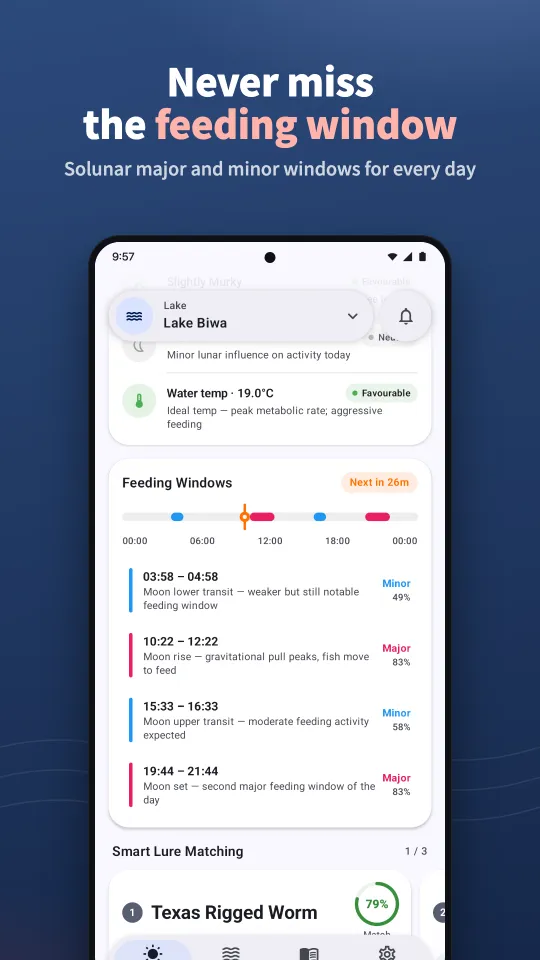
Our app scores major and minor feeding windows for Lake Inawashiro day by day, and its Smart Lure Matching feature suggests what's likely working right now. It's worth checking alongside the wind and weather, not instead of them.

iPhone version coming soon · See everything the app does